
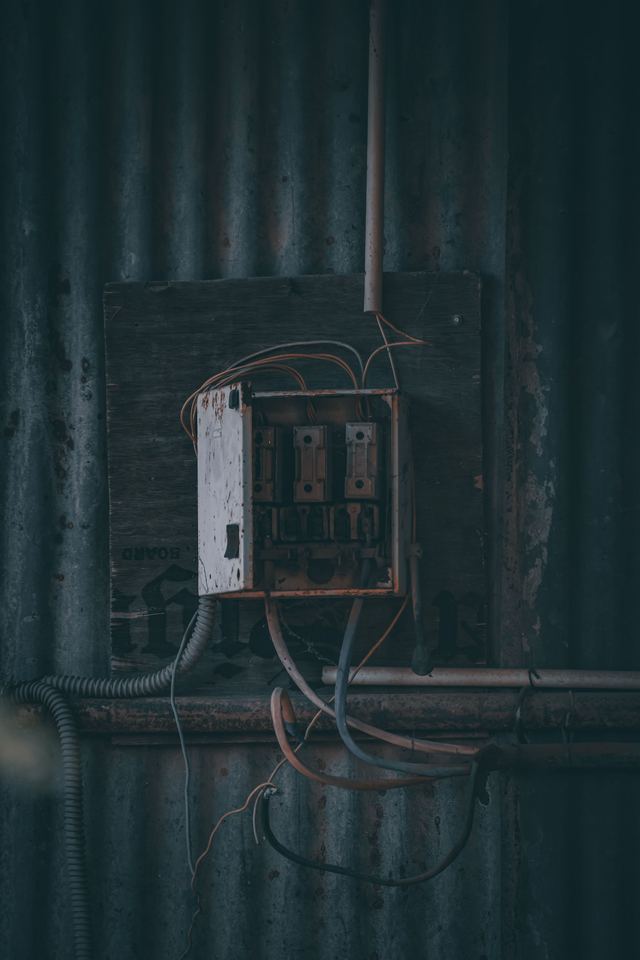
What you're looking at
Behind the meter box door you'll see a row of white or cream ceramic carriers that pull out, each holding a thin fuse wire or a cartridge. That's a rewirable fuse board. If nothing on the board has a test button, there's no safety switch.
A fuse has one job. When a circuit draws more than its cable can safely carry, the wire inside melts and the circuit goes dead. A safety switch, or RCD, does something no fuse can: it notices current leaking to earth, which is what happens when it flows through a person, and cuts the power almost instantly.
Don't pull the fuses out to check them
On boards this old, some fuse carriers, Federal fuses among them, may have friable asbestos inside, and the backing board itself can contain asbestos. If a fuse blows, leave the carriers where they are, switch off and unplug what was running on that circuit, and call an electrician. Asbestos switchboards explains what to look for from a distance.
Why thicker fuse wire is the wrong fix
A fuse that keeps blowing is reporting a problem: too much on one circuit, a faulty appliance, or damaged cable. Ausgrid says to call a licensed electrician straight away when that happens. Heavier wire removes the only protection that circuit has, and lets the cable cook inside the walls.
Queensland, the ACT and the Northern Territory all have laws that put changing a fuse outside the definition of electrical work, within limits. On a ceramic board that may sit on asbestos, we'd still leave it to the electrician.
When the rules make the decision for you
In Queensland, a licensed electrician can't do installation work in a home whose power points have no approved safety switch, unless the job includes fitting one or an exception such as an emergency applies. So if you have an old fuse board and ask for a new power point, expect the quote to include a safety switch.
Consumer Affairs Victoria says some older rentals with fuse boards may need the whole switchboard replaced, with breakers for every circuit. Western Power requires a circuit breaker main switch when circuit capacity is added to an existing home. In the Northern Territory, from 1 December 2028, electrical work on a home generally can't go ahead without an approved safety switch. In New South Wales, Fair Trading strongly recommends a safety switch check for any home built before 2000, and a ceramic fuse board answers that question on sight.
What a fuse box replacement should include
- Taking out the fuse carriers and old panel, with a plan for asbestos if the backing board is the dark, older kind.
- A circuit breaker for every circuit, each matched to the cable it protects.
- Safety switches on the power point and lighting circuits at least. NSW Fair Trading recommends them on every circuit.
- A new main switch, and a look at the main cable coming in from the meter.
- Testing at the end, and your state's compliance certificate.
Your part, and the electrician's
You can
- Find the main switch and know how to turn it off in a hurry.
- Write down which fuse blows and what was running when it did.
- Spread heaters and other heavy appliances across different circuits.
- Photograph the board through the open door for the electrician.
Leave to a licensed electrician
- Changing fuses or fuse wire on an old ceramic board.
- Anything on or behind the panel.
- Replacing the fuse board with breakers and safety switches.
- Checking whether the old wiring will cope once safety switches go in.

Our take
If you still have ceramic fuses, we'd plan the replacement now rather than wait for one to blow on a cold night with the heaters running. Ask for a written quote that puts safety switches on every circuit and says how the backing board will be handled. Mention anything you might add soon, like air conditioning or an EV charger, so the new board has room for it.
Want a specialist to sort it?
Tell us the job and your postcode. We match the licence-checked local electrician who does this kind of work, and they call you. No ring-around, and your number goes to them alone.