Is a fan the right fix for the room?
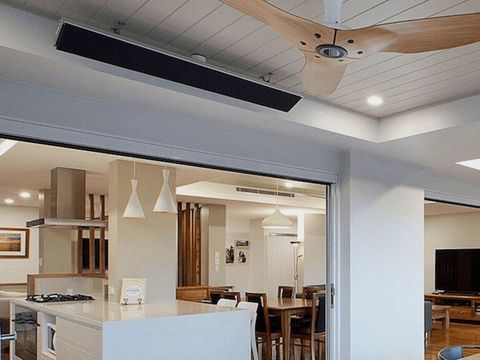
A ceiling fan cools people, not the room. It moves air across your skin, so it works well in bedrooms, living areas and covered outdoor spaces where you sit or sleep, and it uses far less power than air conditioning.
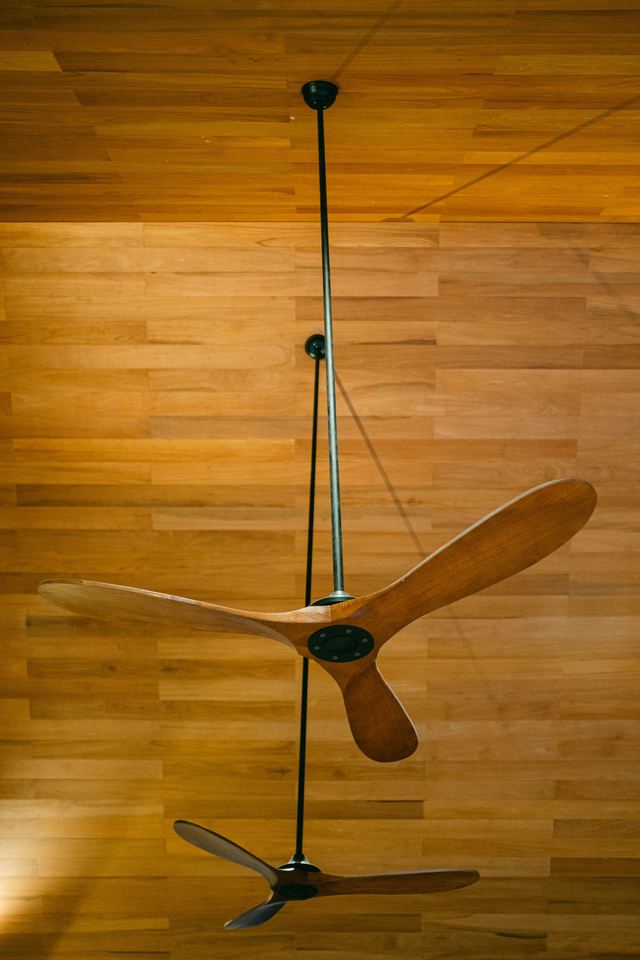
Ceiling height matters. Low ceilings limit which fans suit, and a fan with a light kit hangs lower again, so measure before you shop and read the maker's installation guide for the clearance it needs.
Outside, choose a fan its maker rates for outdoor or damp locations. An indoor fan on an alfresco ceiling isn't built for the moisture, and it won't last.
Wall control, remote or smart: which suits you?
| Wall control | Remote | Smart control | |
|---|---|---|---|
| How you use it | A speed dial or buttons on the wall | A handset, often for the light as well | An app, a voice assistant or a scene button |
| What gets fitted | A fan controller in the wall plate, sometimes beside the light switch | A receiver tucked into the fan's canopy | A smart controller or module from the switch range you choose |
| Worth knowing | Nothing to lose down the side of the couch | Handy where there's no spare spot on the wall plate | Clipsal's 2000 Series has fan speed controllers, and Legrand's Excel Life Smart range includes a smart fan controller |
What the electrician does on the day
First they look at the ceiling from below and, usually, from the roof space. A fan needs a solid fixing, a joist or a purpose-made bracket, because it moves while it runs. Older ceilings sometimes need extra timber fitted between the joists before the fan goes up.
Then the wiring. Swapping an existing light for a fan often uses the cable that's already there, with a fan controller added at the wall. A fan where there's no light point needs a new cable run, which is quicker under an easy roof than in the ceiling between two floors.
In Queensland, the electrician's business has to make sure, as far as reasonably practicable, that the power to the building is off before its worker goes into the roof space. Expect the power to be off for part of the visit.
Last, they balance the blades, run the fan at every speed and give you the paperwork. In New South Wales that's a CCEW (Certificate of Compliance for Electrical Work), needed even when an old fan is replaced like for like. Victoria's is a Certificate of Electrical Safety, Western Australia's an Electrical Safety Certificate, and South Australia's an electronic certificate of compliance (eCoC), due within 30 days.
Fan wobbling hard, smelling hot or sparking? Switch it off
Turn it off at the wall and keep people out from under it. A fan that rocks on its mount, buzzes loudly or smells of burning has a fault you can't fix by tightening something from a ladder. If there's smoke, or sparks you can't stop, turn off the main switch if it's safe to reach and call 000. Have an electrician check the mounting and the wiring before it runs again.
What's yours to do, and what isn't
You can
- Choose the fan, its size and the control you want.
- Measure the room and the ceiling height before you buy.
- Clear a path to the manhole so the electrician can get into the roof space.
- Dust the blades, and use the summer and winter direction setting if your fan has one.
Leave to a licensed electrician
- Taking down a light fitting and putting a fan in its place.
- Fixing the bracket, running any new cable and fitting the wall control.
- Moving a fan, or adding one where there's no light point.
- Any wiring on an outdoor fan.
Worth asking before they start
- Will my ceiling hold the fan as it is, or does it need a brace?
- Can it use the existing light point and switch, or does it need new cable?
- Will the controller you fit suit the fan I've bought?
- Can the fan and its light be switched separately?
- Do you supply the fan, or fit one I've already bought?
- What's your licence number, and which certificate will I get?
Who to match with
Most electricians can hang a fan. The one you want fits them every week, knows the common brands and their brackets, and has dealt with old lath and plaster ceilings and cramped roof spaces before.
If you're also adding downlights or changing switches, one visit from someone who does lighting as well saves a second trip.

If it were our ceiling
We'd measure the room and the ceiling height, decide on the control, and send the electrician the fan's model number and a photo of the ceiling before they quote. If two or three rooms are getting fans, we'd have them all done in one visit, with each fan and its light on separate switching so the light can go on without the fan.
Want a specialist to sort it?
Tell us the job and your postcode. We match the licence-checked local electrician who does this kind of work, and they call you. No ring-around, and your number goes to them alone.