
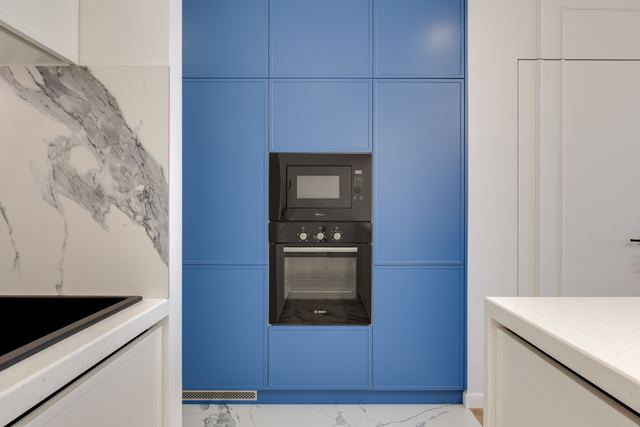
Plug-in or hardwired: who connects it?
| Plug-in | Hardwired | |
|---|---|---|
| How to tell | It comes with a normal plug on the cord | No plug, just a cable or terminals for fixed wiring |
| Usually | Many rangehoods and microwaves, and some smaller ovens | Most cooktops, many wall ovens and freestanding cookers |
| Who connects it | You, into a suitable power point | A licensed electrician |
| New circuit | Only if there's no suitable outlet nearby | Often, especially for induction |
| Certificate | None, because plugging in isn't electrical work | Yes, depending on your state |
Check the circuit before you choose the cooktop
The cut-out in the benchtop is only half the fit. The other half is electrical: what the new appliance draws, what the existing circuit was built for, and whether the switchboard has room for something bigger. The rating plate and the installation manual tell the electrician what it needs.
Induction is the usual surprise. A large induction cooktop can need more than an old electric cooktop's circuit was built for, and a kitchen coming off gas may have no cooktop circuit at all. On Western Power's main grid, the electrical contractor has to assess household demand and apply for an upgraded supply if new circuits would take the home past its standard allocation.
Older Queensland homes have one more thing to check. A licensed electrician there can't do installation work on a house without an approved safety switch on the power points unless the job includes fitting one, so the new oven circuit may arrive with a safety switch.
Swapping gas for induction
Going from a gas cooktop to induction takes two trades: a gasfitter caps the gas, and an electrician runs the new circuit and connects the cooktop. Gas to induction goes through it step by step, including when the switchboard or supply needs work first.
How the job usually goes
Send the details
The model numbers, a photo of the old appliance, and a photo of the closed meter box so the electrician can see what kind of board you have.
Get a written quote
It should say whether the existing circuit will do, or whether a new circuit, an isolating switch or switchboard work is needed.
Disconnect the old one
The electrician disconnects a hardwired appliance. If it runs on gas, the gasfitter does that part.
Fit and connect
Whoever is fitting the kitchen sets the appliance in place, or the electrician does it with the connection. Then they connect it, test it and check every element or zone works.
Get the paperwork
Ask for your state's certificate, and keep it with the manual and the warranty.
The certificate, and when you might not get one
For a new circuit or a hardwired connection, expect your state's certificate. New South Wales requires a CCEW even for like-for-like replacement. In Victoria, the licensed electrician provides a Certificate of Electrical Safety when they complete installation work, and Queensland's certificate of testing and compliance must be given as soon as practicable after connection.
Two places draw the line differently. In the Northern Territory, no certificate is needed to swap an appliance for a similar one in the same spot that works the same way and doesn't draw more power. Western Australia's Electrical Safety Certificate isn't required for like-for-like replacement either. Moving from a basic electric cooktop to a bigger induction one isn't like for like.
Your part, and the licensed part
You can
- Plug in a plug-in appliance, straight into a power point rather than a power board.
- Measure the cut-out and the cabinet, and read the manual's electrical requirements.
- Book the gasfitter if gas is being capped.
- Keep the manual, receipt and certificate together for the warranty.
Leave to a licensed electrician
- Connecting a hardwired oven, cooktop or rangehood.
- Running a new circuit or fitting an isolating switch.
- Adding a power point in the cupboard for a plug-in rangehood.
- Checking the switchboard and supply can carry an induction cooktop.
Ask before you book
- Can the existing circuit run this model, going by its rating plate?
- Does my switchboard have the room and the safety switches for it?
- Who's lining up the gasfitter and the kitchen installer, and in what order?
- Will there be an isolating switch, and where will it go?
- Which certificate will you give me, and what's your licence number?
Why a kitchen specialist helps
Appliance work is often part of a kitchen renovation. An electrician who does it regularly knows the common brands, plans the circuits for the whole kitchen at once and works around the cabinet maker and gasfitter, which saves a second visit when the benchtop goes in.
In New South Wales, some other trades, such as plumbers, can hold a certificate to disconnect and reconnect hard-wired appliances as part of their main work. It doesn't cover fixed wiring, so a new circuit or a fault at the switchboard is still an electrician's job. The ACT has restricted licence classes for narrower work like disconnecting and reconnecting appliances.

Our advice before you order
Before you order an induction cooktop or a bigger oven, send the model to an electrician and ask one question: can my circuit and switchboard run this as they are? If the answer is no, you'll know what's involved before the old cooktop comes out, and you can plan the electrical work around the kitchen instead of the other way round.
Want a specialist to sort it?
Tell us the job and your postcode. We match the licence-checked local electrician who does this kind of work, and they call you. No ring-around, and your number goes to them alone.