
Smell burning, see scorch marks or hear buzzing? Stop here
Don't reset anything. If you can reach the main switch safely, turn it off. If there's smoke, fire or someone has had a shock, call 000, and don't touch a person who might still be in contact with the power. Then get a licensed electrician to look at it before anything goes back on.
What to do right now
Work out which switch tripped
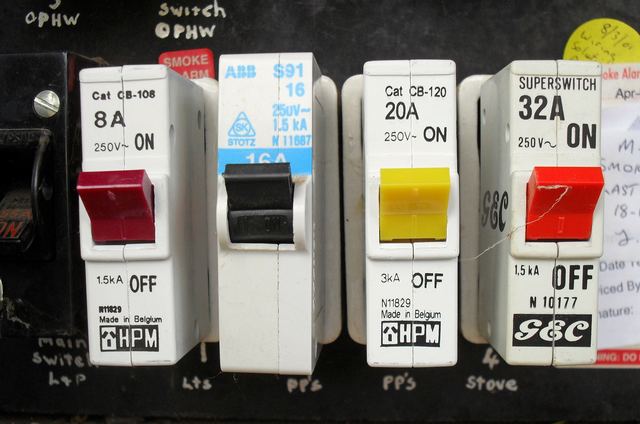
Open the meter box door and look for the switch that's down or in the middle. A safety switch has a test button. A circuit breaker doesn't. Which one tripped tells you a lot.
Unplug everything on that circuit
Go round the rooms that lost power and switch off and unplug everything: kettle, toaster, heaters, chargers, the fridge if it's on that circuit. Turn off fixed appliances at their own switch if they have one.
Reset it once
Push the switch firmly back up. If it stays on with nothing plugged in, the wiring is probably fine and an appliance is the likely cause. If it trips straight away with everything unplugged, stop and call an electrician.
Plug things back in one at a time
Give each one a minute and use it. When the switch trips again, the last thing you plugged in is your suspect. Leave it unplugged and get it checked or replaced.
Don't keep resetting it
Two or three goes is plenty. A switch that keeps tripping with no obvious cause is warning you about something you can't see.
Safety switch or circuit breaker: why it matters which one
A safety switch (an RCD) watches for electricity leaking to earth, which is what happens when current goes somewhere it shouldn't, including through a person. When it trips, the usual suspects are an appliance with a worn element or damaged lead, or water getting into an outdoor power point or light.
A circuit breaker cuts the power when a circuit draws more than it's built for, or when there's a short. Too many heaters and appliances on one circuit is the classic overload, and Ausgrid's advice is no more than one double adaptor per power point. A short is more serious: it often means damaged wiring or a faulty fitting.
Signs it isn't an appliance
- It trips with everything on the circuit unplugged.
- It trips after rain or a storm, which points to water in an outdoor power point, light or cable.
- It trips at random times, with nothing new switched on.
- A power point or switch is warm, discoloured or crackles.
- Lights flicker or dim on the same circuit before it trips.
- It won't reset at all, even with everything unplugged.
What you can do, and what's licensed work
You can
- Reset a tripped switch once or twice, with appliances unplugged.
- Unplug and test appliances one at a time to find a faulty one.
- Spread heaters and heavy appliances across different circuits.
- Press each safety switch's test button every six months, as NSW Fair Trading suggests.
Leave to a licensed electrician
- Taking off any power point, switch, light or switchboard cover.
- Finding a wiring fault, a short or water in a fitting.
- Replacing a breaker or safety switch, or adding a circuit.
- Checking an old switchboard that trips more as the house adds appliances.
Why we're firm about the licensed part
It's tempting to take the cover off a power point that's playing up. Don't. Energy Safe Victoria says doing your own electrical work is illegal and can be deadly, and NSW Fair Trading says unless you're qualified you should never install, replace or move power points, lights, switches or ceiling fans. In New South Wales the fines for unlicensed wiring work are $22,000 for an individual.
Changing a light globe is fine. Anything with a wire behind it isn't.
What to ask the electrician
- Did you find the fault, or just make the switch stop tripping?
- Is any of the wiring on that circuit worn, damaged or overloaded?
- Does the switchboard need upgrading to cope with what we run now?
- Will I get a compliance certificate for the work?
- What's your licence number, so I can check it on the state register?

Where we'd start
Do the unplug-and-test routine once. If it finds a faulty kettle or heater, you've saved a call-out. If the switch trips with nothing plugged in, trips after rain, or won't reset, stop there and get an electrician who does fault finding every week. That's the kind of fault you want found properly, not just reset.
Want a specialist to sort it?
Tell us the job and your postcode. We match the licence-checked local electrician who does this kind of work, and they call you. No ring-around, and your number goes to them alone.