
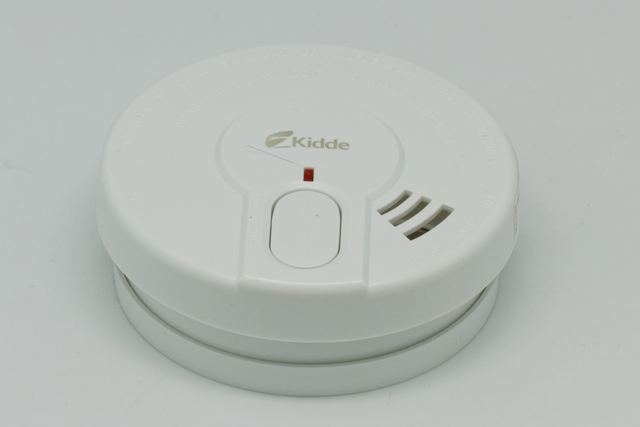
Full alarm, not a chirp? Get out first
If it's sounding the full alarm, treat it as a fire until you know it isn't. Get everyone out and call 000. Never pull the battery out to silence an alarm: Victoria's fire services say removed batteries are a main reason alarms fail in a real fire.
How to stop the chirp
Find which alarm it is
A chirp usually comes from one alarm, so stand under each in turn and listen. If they're interconnected and all went off, alarms made to AS 3786-2014 have an indicator light showing which one triggered first.
Work out what kind it is
Look for a battery door or drawer, a green light (which means it's on mains power), and the date sticker on the side or back.
Change the battery if you can
A removable battery gets a fresh one of the same type. Hardwired alarms have a backup battery too, and changing it is fine. If you'd have to disconnect anything from the wiring to reach it, leave it for an electrician.
Press test, then hush
Press and hold the test button until it beeps. Some models also have a hush button to quiet a nuisance alarm.
Still chirping? Replace the alarm
Victoria's fire services say to replace the whole alarm if it still beeps after a new battery. A sealed 10-year alarm has no battery to change, so a chirp usually means it has reached the end of its life.
What the chirp means, by type of alarm
| Removable battery | Sealed 10-year battery | Hardwired (240 volt) | |
|---|---|---|---|
| Most likely cause | The battery is going flat | The alarm is at the end of its life | A flat backup battery, or the alarm's age |
| What you can do | Fit a new battery | Replace it with a new alarm | Change the backup battery |
| Who replaces the alarm | You can | You can | A licensed electrician |
Why it goes off when there's no fire
Queensland's fire service lists five main reasons an alarm goes off for no clear reason: it's near or past its 10-year life, the backup battery needs replacing, it's the wrong type of alarm for that spot, dust or insects have built up inside, or it's too close to cooking fumes or shower steam.
ACT Fire and Rescue suggests vacuuming the dust off alarms every six months. If cooking or showers keep setting one off, Victoria's fire services suggest swapping an ionisation alarm for a photoelectric one, or adding an exhaust fan.
On a mains alarm, the green light shows it's connected to power. If it's off, there may be a fault in the alarm or the wiring, and that needs an electrician. The date sticker tells you when the 10-year life is up.
Renting? Whose job is the battery?
It depends on the state. In NSW, the landlord replaces removable batteries every year and has two business days to fix an alarm that isn't working. In Queensland and the ACT, the tenant looks after batteries during the tenancy. In Victoria, a faulty alarm is an urgent repair for the rental provider.
Our guide to electrical rules for landlords covers each state.
What you can do, and what needs an electrician
You can
- Change a removable battery, or a hardwired alarm's backup battery.
- Press the test and hush buttons.
- Vacuum dust off the alarm.
- Replace a battery-only alarm, or fit wireless alarms with a sealed 10-year battery, which the Queensland Fire Department says you can install yourself.
Leave to a licensed electrician
- Replacing or moving a hardwired alarm.
- Wiring mains alarms together so they're interconnected.
- Finding out why the green mains light is off.
- In WA, connecting or disconnecting any mains-powered alarm.

If it starts chirping at night
Swap the battery if you have a spare, and check the date sticker in the morning. If the alarm is close to 10 years old, we wouldn't bother with batteries: replace it. And if your alarms are hardwired, get an electrician who fits alarms regularly to replace the lot at once, so they match and work together.
Want a specialist to sort it?
Tell us the job and your postcode. We match the licence-checked local electrician who does this kind of work, and they call you. No ring-around, and your number goes to them alone.