
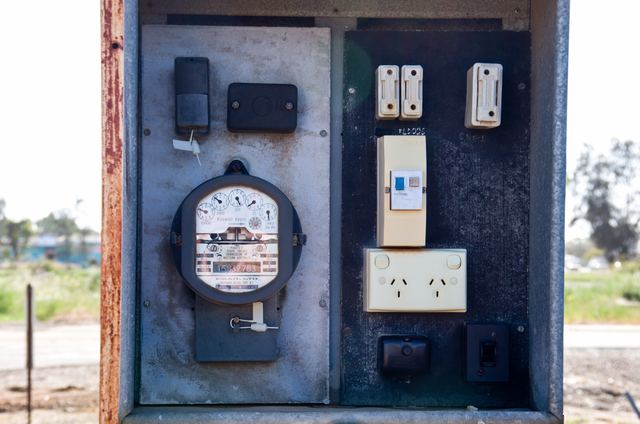
What's in the box, and who owns it
Start at the street. The service line brings power from the network's pole or pit to your point of connection, and the consumer mains run from there to your main switch. The meter measures what you use, and the main switch and the board's breakers and safety switches look after your circuits.
The meter board belongs to the property: Essential Energy says meter boards are the property of the owner of the premises. The meter usually isn't yours. On most networks your retailer arranges it, and CitiPower and Powercor own and manage the meters on theirs. In Tasmania, meters installed since 1 December 2017 aren't owned or maintained by TasNetworks.
Black or brittle meter board? Ask about asbestos first
Homes built before 1988 may have a meter board containing bonded asbestos, Essential Energy warns. Don't drill, screw into or sand it, and tell any electrician before they quote so they can explain how they'll manage it. In the ACT, no one may remove asbestos without the right licence apart from work incidental to minor maintenance, so a licensed removalist may need to be part of the plan. Asbestos switchboards explains the rest.
How a new connection or supply upgrade usually runs
The electrician works out what you need
They assess the load, meaning what the house will run at the same time, and decide the supply size, the meter position and the switchboard layout.
An application goes to the network
Usually through the network's portal: eConnect for CitiPower and Powercor, the Jemena Electricity Portal, myEnergy for United Energy, EnergyConnect for AusNet, and the Connections Portal for Endeavour Energy and TasNetworks. For a new home under 100 amps, SA Power Networks recommends an electrician or electrical consultant applies.
The supply side is built
In New South Wales, a Level 2 Accredited Service Provider builds or alters the service line and energises the connection. Elsewhere the network tells your electrician how its side is handled. SA Power Networks, for example, says it builds in about six weeks after its technical assessment.
The meter goes in
On most networks your retailer arranges it, so call them when the electrician says it's time.
Inspection, certificate, power on
In Victoria, consumer mains are prescribed work: a licensed electrical inspector checks them within 8 business days, and they can't be switched on before that. The ACT audits every new installation before it's energised. In South Australia, a missing certificate of compliance on site is one reason a connection fails on the day.
Who does what in your state
New South Wales. Work between the network and your property is contestable, so you choose who does it, as long as they're accredited. Level 2 ASPs build and alter service lines, energise connections and work on the service protection device on the main switchboard. Energy NSW suggests getting at least three quotes, and the ASP Scheme portal lists providers. Our Level 2 electrician page has more.
Victoria. Connections follow the Victorian Service and Installation Rules, the current edition dated May 2026. On CitiPower and Powercor, only a Registered Electrical Contractor can apply to change an existing supply, meter and meter panel upgrades included.
Queensland. On Energex's network, the electrician lodges changes as an Electrical Work Request, and meters are arranged through your retailer, which appoints a metering coordinator.
South Australia, Tasmania and the ACT. SA Power Networks can't help with meter alterations, so those go through your retailer, and Evoenergy in the ACT says your retailer installs, maintains and replaces meters. In Tasmania, only licensed electrical contractors can register to lodge electrical works requests with TasNetworks.
For Western Australia, Essential Energy, Ergon Energy, Horizon Power and Power and Water, we haven't confirmed who arranges each step of a new connection or meter move, so your electrician should check with the network before quoting.
Signs the meter box needs attention
- A dark, brittle or cracked meter board, especially in a home built before 1988.
- No room for a smart meter, a solar meter or a bigger main switch.
- A defect notice from the network, for something like a loose or missing service hook.
- Trees growing into the line that runs to the house.
- A meter box that's been under water. Leave everything off until an electrician has checked it.
- A meter that has stopped or shows an error. Report it to your retailer.
Your jobs, and the licensed ones
You can
- Report a faulty meter to your retailer. Ausgrid says the retailer should arrange a replacement within 15 business days.
- Keep trees clear of the service line, using an authorised contractor near the lines. In the ACT, Evoenergy's minimum is 1 metre.
- Act on a defect notice quickly.
Leave to a licensed electrician
- Consumer mains, the main switch, the meter panel and the switchboard.
- The network application and, in Victoria, arranging the inspection.
- In New South Wales, service line and connection work, by a Level 2 ASP.
- Any work on a meter board that may contain asbestos.
Questions for the electrician
- Who lodges the network application, and who's booking the meter?
- Does the service line or consumer mains need replacing, and who does each part?
- Could the meter board contain asbestos, and how will you handle it?
- In Victoria, when will the inspection happen, and when can the power go back on?
- Which certificate will I get, and does the network get a copy?

What we'd do first
We'd call the electrician before the retailer or the network. Ask them to map out who does each part, from the street to your switchboard, and put it in the quote with names and timing. These jobs stall when one party is waiting on another, and an electrician who does mains and meter work regularly knows the order to book everyone in.
Want a specialist to sort it?
Tell us the job and your postcode. We match the licence-checked local electrician who does this kind of work, and they call you. No ring-around, and your number goes to them alone.