Burning smell or scorch marks around a downlight?
Switch that light off and leave it off. If the smell is strong, you see smoke, or you can't tell where it's coming from, turn off the main switch if it's safe and call 000. Don't climb into the roof space to look. Have a licensed electrician check the fitting, the transformer and the insulation around it before it's used again.
Halogen to LED: what actually changes
Many older downlights are low-voltage halogens, each running off a transformer that sits in the ceiling. They run hot and use far more power than LED. A proper upgrade replaces the whole fitting, transformer included, with an LED downlight that has its own driver (its power supply).
Some people put LED globes into the old halogen fittings. It can work, but an old transformer that wasn't made for LEDs is a common cause of flicker and early failure. Swapping a globe is fine to do yourself. Changing the transformer or the fitting is licensed work.
LED downlights come in a range of sizes, so new fittings don't always match the old holes. A slightly larger trim covers an old hole neatly; a smaller fitting means patching or a cover plate.
Signs your old downlights need attention
- The fitting, or the ceiling around it, is discoloured or scorched.
- A transformer buzzes, or lights flicker or die early.
- Globes keep failing one after another in the same fitting.
- Fittings get very hot, or there's a warm smell after they've been on a while.
- Insulation has been pushed up against or over the old fittings.
Insulation, heat and the roof space
Heat is why insulation and downlights need care. Old halogen fittings need clearance so insulation isn't packed against them. Many LED downlights are made to be covered by insulation, but not all, so ask what the new fittings are rated for before anyone lays insulation back over them.
Most of the work happens in the roof space, which is hot, cramped and full of cable. Queensland's Electrical Safety Regulation 2026 requires a business to make sure, as far as reasonably practicable, that a building's power is off before its worker enters the roof space.
In an older home, think about asbestos before anyone cuts a new hole. The Victorian Government's Asbestos Hub says a home built or renovated before 1990 likely contains asbestos, and WA bans high-speed power tools for cutting, sanding or drilling asbestos materials. If your ceiling sheets might contain it, say so when you book.
Planning a layout
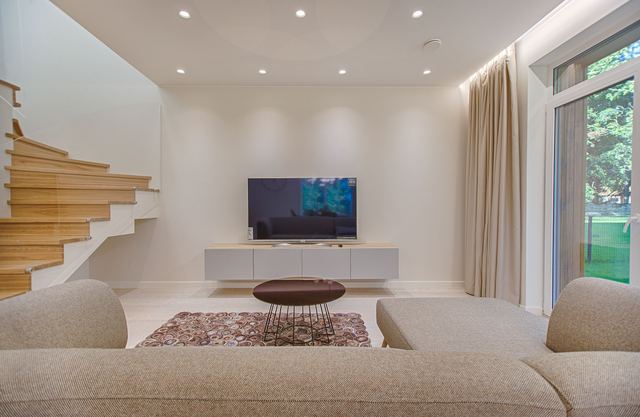
The usual mistake is too many downlights in a neat grid. Light the walls and the places you work rather than the middle of the floor, keep fittings clear of joists and roof framing, and think about glare from where you sit on the couch or lie in bed.
Colour matters as much as brightness. Warm white suits living areas and bedrooms, and cooler white suits kitchens, laundries and garages. Colour-switchable downlights let you choose once they're in, which helps if you're unsure.
Some ceilings don't suit recessed downlights at all: concrete slabs, raked ceilings with no space above, and heritage ceilings you don't want to cut. A surface-mounted fitting or another kind of lighting may suit better there.
Dimming, and why the specialist matters
If you want them dimmable, every downlight on that dimmer needs a dimmable driver that suits it. Mixing brands, or old and new fittings, on one dimmer is a common cause of flicker. Dimmers have load limits too: Clipsal's Iconic Wiser connected smart dimmer, for example, is rated at 300 W, so the lights it controls have to fit within that.
An electrician who fits downlights all the time knows which drivers and dimmers get along, carries the common fitting sizes, and can tell quickly whether the old cable will cope. When the job's done, expect your state's certificate: a CCEW in New South Wales, a Certificate of Electrical Safety in Victoria, a certificate of testing and compliance in Queensland, or an eCoC within 30 days in South Australia.
What's yours to do, and what's licensed
You can
- Change a globe in a downlight that takes a replaceable one, with the switch off and the fitting cool.
- Count your downlights and note which switch controls each group.
- Note any brand or model printed on the old fittings, if it's visible from below.
- Tell the electrician about ceiling sheets that might contain asbestos.
Leave to a licensed electrician
- Replacing a downlight fitting, transformer or driver.
- Cutting new holes and running cable to them.
- Fitting dimmers and matching them to the drivers.
- Moving insulation around old fittings in the roof space.
What the quote should say
- How many downlights, the make and model, and whether they're dimmable.
- That the old transformers come out, and how the new drivers connect.
- Whether the new fittings can be covered by insulation.
- Whether existing holes are reused, and who patches any that aren't.
- The colour: warm, cool or switchable.

What we'd ask for
If you've still got halogen downlights, we'd replace them with LED fittings rated to be covered by insulation, take the old transformers out at the same time, and have the electrician look over the cable and insulation while they're up there. Go warm white in living areas unless you're sure, and only add dimming where you'll actually use it.
Want a specialist to sort it?
Tell us the job and your postcode. We match the licence-checked local electrician who does this kind of work, and they call you. No ring-around, and your number goes to them alone.