
Signs your switchboard is due
Open the meter box door (just the door, not any cover inside) and look. Ceramic fuses you pull out and rewire are the clearest sign: that board was built before safety switches were common. No safety switches at all is the other big one. They're the switches with a test button, sometimes labelled RCD.
The rest are about what the house needs now. Breakers that trip whenever the heater and kettle run together. A board with no spare space when you want an EV charger, solar or an induction cooktop. A renovation that adds rooms and circuits. Any of these is a reason to have an electrician look before you add anything new.
A dark board behind the fuses? Don't drill, sand or poke at it
Black or dark brown backing boards made before 1987 can contain asbestos, and some carry names like Lebah, Zelemite or Ausbestos on the back. Some old fuses on them can have asbestos inside the fuse carrier too. Leave it closed and tell the electrician when you book. They'll work out whether it needs a licensed asbestos removalist before the new board goes in.
What the electrician actually changes
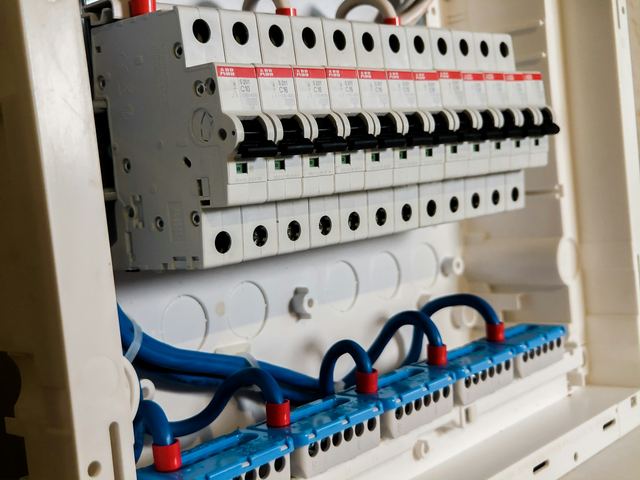
Most upgrades replace the old fuses with circuit breakers, add safety switches to protect the power point and lighting circuits, and tidy the wiring into a new enclosure with room to spare. If you're adding a big load like an EV charger, they'll check whether the supply into the house can carry it as well.
Sometimes the job reaches past the switchboard to the meter or the service line from the street. In New South Wales that part is done by a Level 2 Accredited Service Provider, an electrician accredited to work between the network and your property. Level 2 electricians explains when you need one. In other states, the electrician will tell you who arranges the meter side.
When it's finished, they test the work and give you a certificate. In New South Wales it's a Certificate of Compliance for Electrical Work (CCEW), and one is required even for like-for-like replacement. In Victoria it's a Certificate of Electrical Safety (COES). Queensland calls it a certificate of testing and compliance, and Western Australia an Electrical Safety Certificate. Keep yours with the house papers.
The rules when you sell or rent
In Queensland, a seller has to tell the buyer in writing whether an approved safety switch protects the power points. If there isn't one, the new owner has 90 days to have it installed. Landlords have the same 90 days from the start of a tenancy.
In Western Australia, safety switches must protect every power point and lighting circuit before a sale settles, and at least two is the minimum. Landlords need them in the switchboard too. In Victoria, rental properties have needed modern switchboards with circuit breakers and safety switches since 29 March 2023.
NSW Fair Trading strongly recommends that anyone in a home built before 2000 has a licensed electrician check whether safety switches are fitted. Your state's rules are on safety switch rules when you sell or rent.
What you can do, and what's licensed work
You can
- Find your main switch and know how to turn it off.
- Press the test button on each safety switch. NSW Fair Trading suggests testing them at least every six months.
- Note which breaker trips and what was running at the time.
- Take a photo of the closed meter box and board so the electrician knows what they're walking into.
Leave to a licensed electrician
- Anything behind a cover: fuses, breakers, wiring, the main switch.
- Swapping fuses for breakers, adding safety switches or new circuits.
- Checking whether the supply can carry an EV charger, solar or an induction cooktop.
- Working out whether an old backing board needs an asbestos removalist.
What a good written quote covers
- What comes out and what goes in: breakers, how many safety switches and which circuits they protect.
- Whether the meter, main switch or service line is involved, and who arranges that part.
- How an old backing board will be handled if it might contain asbestos.
- Spare space left for what you've said you'll add later.
- How long the power will be off, so you can plan the fridge and work from home.
- The certificate you'll get at the end, and the electrician's licence number.
Why the specialist matters here
Plenty of electricians can swap a board. The one you want does them every week, and knows what your plans mean for it. If an EV charger is coming, match with someone who does chargers and the switchboard work they need, so the board is sized once instead of twice.
In New South Wales, the Home Energy Saver scheme offers interest-free loans of up to $15,000 for approved energy upgrades, and they can cover a switchboard upgrade alongside an EV charger. Check the scheme's own page for what's approved before you book.

What we'd do
If your board still has ceramic fuses or no safety switches, we'd get it looked at before adding anything new, not after something trips or overheats. Tell the electrician everything you're planning for the next few years in the first conversation, ask for the certificate when they finish, and test your safety switches yourself twice a year from then on.
Want a specialist to sort it?
Tell us the job and your postcode. We match the licence-checked local electrician who does this kind of work, and they call you. No ring-around, and your number goes to them alone.