
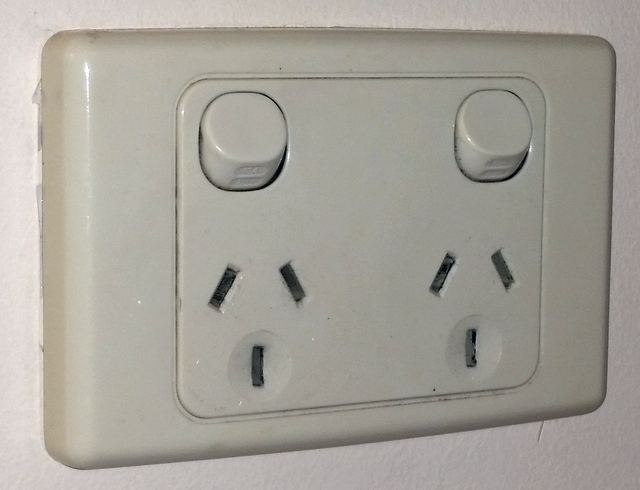
Signs it's time for more outlets, or a repair
- Power boards plugged into power boards, or a double adaptor in every outlet. Ausgrid's advice is one double adaptor per power point, at most.
- A plug that falls out or feels loose in the socket.
- A faceplate that's cracked, scorched or brown around the pins. The NSW Government says broken power points should be replaced.
- A buzz, crackle or spark when you plug something in.
- One outlet that's dead while the rest of the room works.
- Extension leads under rugs or across doorways to reach a bench or a bed.
Hot, scorched or sparking power point? Stop using it
Switch it off at the outlet and unplug whatever's in it, if you can do that without touching anything hot. If it's smoking or the smell keeps coming, turn the power off at the main switch if it's safe to reach, and call 000 if there's fire. Leave the faceplate on. A loose or burnt connection behind it is exactly the kind of fault that needs a licensed electrician.
Where extra power points earn their keep
The kitchen bench, where the kettle, toaster and air fryer fight over two outlets. Bedsides and desks, for phones and laptops. The TV wall, so cables don't trail across the room. The garage or shed, for tools and a second freezer.
Older homes usually have far fewer outlets than a modern household uses, which is how the power boards creep in. In New South Wales, rental minimum standards say a rental must have enough electricity or gas outlets for lighting, heating and appliances.
Outdoor and USB versions have their own pages: outdoor power points and USB power points.
What the electrician checks first
Before adding an outlet, a good electrician works out which circuit it will join, what's already on that circuit and whether a safety switch protects it. A new double outlet beside the bench isn't much help if it shares a circuit that's already carrying the heater and the kettle.
Queensland goes a step further. Its rules say a licensed electrician mustn't do installation work in a home with no approved safety switch for the power points, unless the job includes fitting one or a listed exception such as an emergency applies. In an older Queensland house, one new outlet can bring a safety switch with it.
Getting cable to the spot is the other half of the job. Timber-framed walls with roof access are the easy case. Double brick, concrete slabs and the ground floor of a two-storey home take more work, and sometimes neat surface-mounted conduit is the sensible answer.
What you can do, and where it stops
You can
- Spread heavy appliances across different outlets and rooms.
- Swap a tangle of adaptors for one power board while you wait for the electrician.
- Press the safety switch test button and note which outlets go off.
- Mark which outlets are dead, loose, cracked or warm.
- Choose the switch range and colour you'd like.
Leave to a licensed electrician
- Replacing a cracked, loose or scorched power point.
- Adding a new outlet or moving one to a better spot.
- Turning a single outlet into a double, or fitting USB or weatherproof ones.
- Finding out why an outlet is dead once the safety switch has been checked.
What a good quote spells out
- Each new outlet and where it goes: single or double, and any USB or weatherproof ones.
- Which circuit each one joins, and whether a new circuit is needed.
- Whether a safety switch protects those circuits, and what happens if one doesn't.
- How the cable gets there: through the wall cavity, chased into brick or in conduit.
- Who patches and paints any plaster or render afterwards.
- The faceplate range and colour, the electrician's licence number and the certificate you'll get.
The certificate, and the bits you can see
Energy Safe Victoria counts power points as non-prescribed work, and for that kind of job the electrician must give you a Certificate of Electrical Safety within a month. In New South Wales a CCEW is needed even for a like-for-like swap. Since 1 July 2026 it's lodged through the Building Commission NSW eCert portal, and if you give the electrician your email, the system sends you a copy.
If you're buying the fittings yourself, look for the Regulatory Compliance Mark (RCM): in-scope electrical equipment must not be sold in Australia without it. Ranges like Clipsal Iconic, the Clipsal 2000 Series and HPM Excel are on our switch range pages.

Our take
Walk the house with a notepad before you call anyone. Note every power board, every adaptor and every spot where you wish there was an outlet, then get them all quoted in one go. One visit to run cable to five places beats five separate call-outs, and the electrician can check the circuits and safety switches once for the lot.
Want a specialist to sort it?
Tell us the job and your postcode. We match the licence-checked local electrician who does this kind of work, and they call you. No ring-around, and your number goes to them alone.