
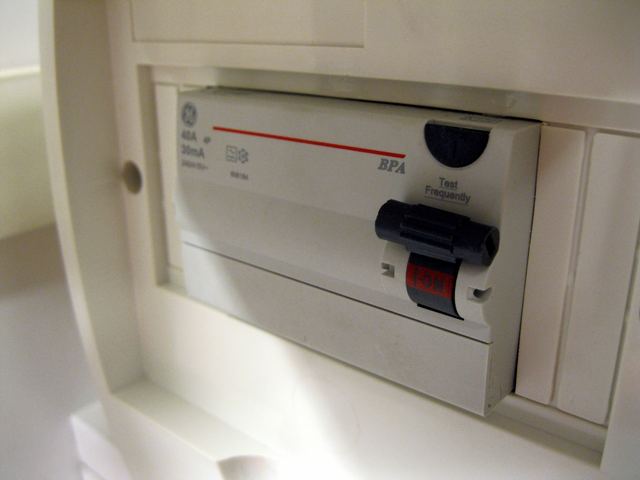
Have you got them, and on which circuits?
Open the meter box door and look at the switchboard without touching anything inside. A safety switch has a small test button, often marked T or Test, and may be labelled RCD or RCBO (a breaker and safety switch in one). Plain circuit breakers don't have one.
Plenty of homes have a safety switch on the power points and nothing on the lights. If your board still has ceramic fuses, it's unlikely to have any, and old fuse boxes is the page to read next. For homes built before 2000, NSW Fair Trading strongly recommends a licensed electrician checks, and it recommends safety switches on every circuit.
Safety switch, circuit breaker or fuse?
| Safety switch (RCD) | Circuit breaker | Rewireable fuse | |
|---|---|---|---|
| Watches for | Current leaking to earth | Too much current, or a short | Too much current, or a short |
| Protects people from shock | Yes, that's its job | No | No |
| Test button | Yes | No | No |
| Found on | Modern boards, often several | Modern boards, one per circuit | Older boards, often with no safety switch at all |
The rules when you sell, rent or renovate
Queensland. A seller must tell the buyer in writing, on or before the day they take possession, whether an approved safety switch protects the power points. Without one, the buyer has 90 days after taking possession to get it installed, and a landlord has 90 days after a tenancy starts. Approved means an RCD approved for use in Queensland that trips at no more than 30 milliamps.
Renovating in Queensland? An electrician can't do installation work in a home with no approved safety switch on the power points unless the job includes fitting one, apart from a few exceptions such as emergencies.
Western Australia. Before the title transfers on a sale, safety switches must protect every power point and lighting circuit, and Building and Energy says at least two is the minimum. Rentals need at least two covering all the lighting and power circuits, and short-stay rentals need them before guests arrive.
Victoria. Since 29 March 2023, rentals have needed a modern switchboard with circuit breakers and safety switches, and from 25 November 2025 a rental must meet that standard when it's advertised.
Northern Territory. The rules were rewritten on 28 May 2026, and landlords no longer have a separate set to follow. One rule is left, covering every home including rentals: from 1 December 2028, no one can do electrical work on a home's installation unless an approved safety switch is fitted, except to connect the home or for urgent or emergency work.
New South Wales has strong advice rather than a retrofit rule we've found, and a faulty safety switch in a rental is an urgent repair. For South Australia, Tasmania and the ACT we haven't found an official rule at sale or lease. Our guide to safety switch rules when you sell or rent goes state by state.
What the electrician does
First they check the board. If it already takes circuit breakers, safety switches can usually go in alongside them. If it's an old fuse board, or there's no room, they come as part of a switchboard upgrade.
Before switching on, a careful electrician tests the existing circuits for leakage. An old heater element or a damp outdoor light can leak just enough to trip a new safety switch straight away, and it's better found on the day than in the middle of the night.
Then they test each switch, label the board and give you the certificate. In Queensland that's a certificate of testing and compliance, showing the contractor's licence number. Western Australia's Electrical Safety Certificate form asks outright whether every power point and lighting circuit is protected by at least two RCDs.
How to test yours
Warn the household
The circuits on that switch will go off for a moment, so save anything on the computer first.
Press the test button firmly
The switch should snap to off and the power on its circuits should drop. Push it back up and reset any clocks.
If it didn't trip, call an electrician
A safety switch that doesn't trip on test isn't protecting anyone. Western Australia's Building and Energy says a faulty RCD must be replaced immediately.
Put the next test in the calendar
NSW Fair Trading suggests every six months. Building and Energy in WA says every three months, or more often if the maker says so.
Your part, and the electrician's
You can
- Press the test button on each safety switch. Queensland's rules confirm it's a test anyone can do without a licence.
- Reset a tripped switch once, with the appliances on that circuit unplugged.
- Write down which circuits each switch protects.
Leave to a licensed electrician
- Installing or replacing a safety switch. In WA, Building and Energy says that's for a licensed electrical contractor.
- Fixing a fault found when testing one.
- A switch that won't reset, or trips with nothing plugged in.
Ask before you say yes
- Which circuits will be protected, and by how many safety switches?
- Will my board take them, or does it need replacing?
- Will you test the existing wiring for leakage before you switch on?
- If I'm selling or renting, will the certificate show what my state's rules ask for?
- Can I have your licence number to look up?

If it were our board
If there's no test button anywhere on the switchboard, we'd have safety switches fitted before any other electrical job, and before a tenant moves in. If there's only one, we'd ask an electrician to put the lights and the remaining power circuits on safety switches too. Then we'd test them on the same two dates each year, and replace any that don't trip.
Want a specialist to sort it?
Tell us the job and your postcode. We match the licence-checked local electrician who does this kind of work, and they call you. No ring-around, and your number goes to them alone.