
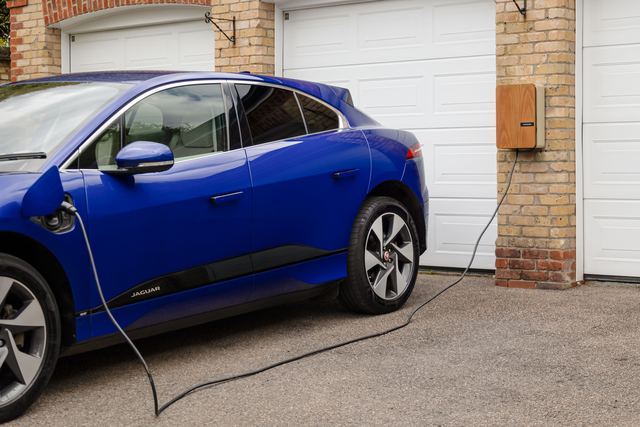
Power point or wall charger?
| Power point and portable cable | Wall charger | |
|---|---|---|
| What the NSW Government calls it | Level 1 charging | Level 2 charging |
| Speed, by WA Government estimates | About 2.2 kW from a 10 amp point, adding roughly 10 to 15 km of range an hour. A 15 amp point runs at about 3.7 kW, roughly 15 to 20 km an hour | A 7 kW charger adds about 30 to 40 km an hour, 11 kW about 50 to 60 km, and 22 kW about 100 to 120 km, if the car can take it |
| Empty to full, by ACT Government figures | 15 to 30 hours from a standard 10 amp socket | About 6 to 9 hours for a standard EV on a 7 kW charger |
| Who installs it | Nobody, if a suitable point is already there. A new or upgraded point is licensed work | A licensed electrician, on its own circuit |
Why a bigger charger isn't always faster
Your car sets the ceiling. The NSW Government notes that not all EVs can charge at 22 kW AC, and the ACT Government says plug-in hybrids often can't make much use of faster chargers. Real speeds also shift with the weather and the battery's charge level.
So the useful question is how many kilometres you need back each night. By the ACT Government's figures, a 15 amp socket upgrade adds over 220 km of range from an overnight charge. The EV charging time calculator runs the numbers for your car.
What the electrician checks before you buy
The WA Government's list is a good one: whether the home has single-phase or three-phase supply, whether the wiring can handle the extra load, and whether the switchboard has space for a new breaker or needs an upgrade. Switchboard upgrades for solar and EV chargers covers that part.
Your network may have a say. Western Power allows a 7 kW single-phase charger on a standard home connection if the total load stays within the supply limit. Ausgrid says homes over 20 years old that haven't been rewired may need a meter upgrade, and Endeavour Energy expects the electrician to tell it if the switchboard or meter box needs upgrading. In the ACT, Evoenergy recommends three-phase power for a charger over 7 kW.
In September 2026, SA Power Networks said its approval is no longer needed for a home charger that isn't vehicle-to-grid capable, though every installation still needs an eCoC. Chargers that can send power back need extra approval on several networks, including Western Power, Endeavour Energy and TasNetworks.
Smart, solar-aware or plain
A smart charger lets you schedule charging and control it from your phone, which the WA Government says can help on a time-of-use tariff. With solar, the NSW Government's advice is to charge during the day, and solar-aware chargers send your surplus to the car. Load management slows charging when the rest of the house is busy.
Whichever you pick, the NSW Government advises a charger carrying the Regulatory Compliance Mark (RCM). Home EV chargers compared has the makes and their specs.
Apartments and strata
In a NSW apartment you need strata approval for a wall charger. On 16 October 2026 the NSW Government announced Parliament had passed a bill giving owners the right to install EV charging on their own lot without unreasonable objection from the strata committee. No start date was given. Until it starts, take the electrician's plan to the committee early.
Loans that can help
NSW Home Energy Saver loans are interest-free loans of up to $15,000, repayable over up to 10 years, and a Level 2 charger and a switchboard upgrade are both on the approved list. The loans are for property owners, including landlords, who are Australian citizens or permanent residents with a combined taxable household income of up to $210,000 a year. The work must be done by an electrician with a current NSW licence.
In the ACT, EV charging equipment is on the eligible list for the Sustainable Household Scheme, which offers loans of $2,000 to $20,000 at 3% interest. We haven't confirmed any other current home charger rebate, so check EV charger rebates and programs by state before counting on one.
Your part, and the electrician's
You can
- Check your car came with a portable charging lead. The ACT Government notes not every maker includes one.
- Plug the lead straight into the power point. The ACT Government warns an extension cord is impractical or illegal.
- Work out your usual daily kilometres, so the charger suits how you drive.
- Book the install before the car arrives if you've nowhere to charge yet.
Leave to a licensed electrician
- Installing a wall charger, or a new or upgraded power point for charging.
- Checking the supply, the switchboard and the total load on the house.
- Telling or applying to the network, where it asks for that.
- Issuing your state's certificate: a CCEW in New South Wales, a COES in Victoria, an Electrical Safety Certificate in Western Australia, an eCoC in South Australia.
What to ask a charger installer
- Is my supply single-phase or three-phase, and what charger size does that suit?
- Does my switchboard have room, or does it need work first?
- Does my network need to know about this charger?
- Can it manage its load, and use my solar surplus now or later?

Our take
We'd size the charger to your car and your driving, not the biggest box on the shelf. For plenty of single-car homes that's a 7 kW wall charger, and some manage on a 15 amp point. Get the board checked before you buy, by someone who installs chargers often: Solar Victoria and Energy NSW both suggest an electrician with EV charger experience.
Want a specialist to sort it?
Tell us the job and your postcode. We match the licence-checked local electrician who does this kind of work, and they call you. No ring-around, and your number goes to them alone.