
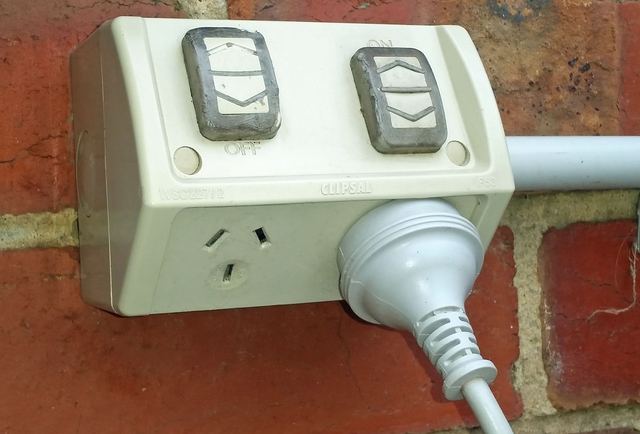
What makes an outlet weatherproof
Outdoor outlets carry an IP rating, which tells you how well they keep out dust and water. Clipsal's Iconic Outdoor range, for example, lists its power points at IP54 and its switches at IP56, and HPM's Excel range includes IP56 weatherproof switches. The outlet should suit where it'll sit, whether that's under a roof or out in the open.
Look for a cover that closes over the plug while something's plugged in, not just when the outlet is empty. That's what stops a pressure washer or festoon lead sitting in rain.
The circuit should be on a safety switch (an RCD, which cuts the power fast if current leaks to earth). NSW Fair Trading recommends safety switches on every circuit, and outside is where they earn their keep.
Where it goes changes the job
An outlet on an outside wall that backs onto a room with power is often the simplest version. A power point at the back fence, beside the pool equipment or out at a shed needs cable run underground or along a structure in conduit, and that's where most of the work is.
Think about what you'll plug in. A speaker and a string of lights need very little. A pool pump, spa heater or workshop tools may need a circuit of their own, and the electrician will check your switchboard has room. One who does a lot of outdoor and pool work will ask these questions before you've thought of them.
Charging an EV from an outdoor power point
Plenty of people start with the car's portable cable in a carport outlet. The WA Government says a standard 10 amp power point charges at about 2.2 kW, adding roughly 10 to 15 km of range an hour, and a 15 amp socket about 3.7 kW, or 15 to 20 km an hour. In South Australia, SA Power Networks needs no approval for charging from a regular 10 or 15 amp power point.
Don't run an extension lead to the car: the ACT Government warns that can be impractical or illegal. If the outlet is too far from where you park, have one put where the car sits, or look at a wall charger. EV charger installation covers that option.
Signs an outdoor power point needs attention
- The cover is cracked, missing or won't stay shut.
- It trips the safety switch after rain.
- There's discolouring or scorching around the sockets or on a plug.
- Plugs feel loose or fall out.
- It's an indoor-style outlet that has ended up outside, even under a roof.
Safe for you, and licensed work
You can
- Keep covers shut and outlets clear of sprinklers and hoses.
- Use outdoor-rated leads, and unplug them before heavy rain.
- Press the safety switch test button so you know it trips.
- Tell the electrician what you'll plug in and how far from the house.
Leave to a licensed electrician
- New outdoor power points, or moving an existing one.
- Replacing a cracked or damaged outlet.
- Running cable underground, or out to a shed or pool.
- A dedicated circuit, or a 15 amp outlet for EV charging.

What we'd ask for
We'd ask for outlets where you'll actually use them, a cover that seals with a plug in, and a clear answer on whether the circuit is on a safety switch. If an EV is coming, we'd have a dedicated outlet put in the carport now and talk about whether a wall charger makes more sense later. And we'd retire every extension lead that currently runs through a window.
Want a specialist to sort it?
Tell us the job and your postcode. We match the licence-checked local electrician who does this kind of work, and they call you. No ring-around, and your number goes to them alone.