
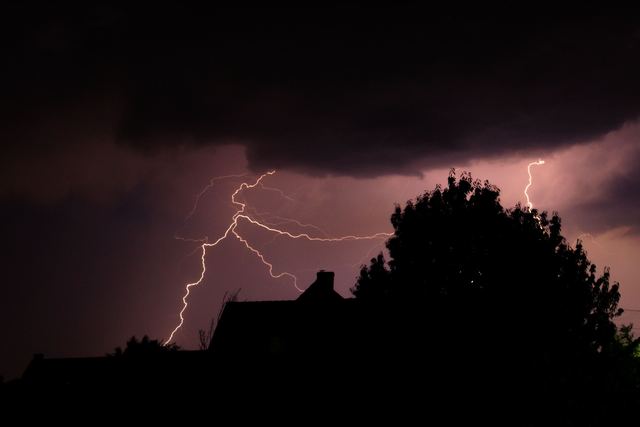
Where surges come from
A surge is a brief spike in voltage, far above what your appliances are built for. Lightning near the power lines is the cause most people picture, but faults on the network can do it too.
In September 2026 a vehicle hit a power pole near Merbein, causing what Powercor called a high voltage injection, a major power surge. It cut supply to more than 5,000 customers around Mildura and damaged some home wiring and appliances. Powercor then required homes with damaged wiring to have an electrician repair it and issue a Certificate of Electrical Safety before supply was reconnected.
What a surge protector does, and what it doesn't
A surge protection device (SPD) sits in the switchboard between the supply and earth. When the voltage jumps, it gives the excess an easier path to earth than through your fridge or TV. It works best as the first layer, with plug-in surge boards on sensitive electronics as the second.
It can't stop a direct strike, and it doesn't replace safety switches or circuit breakers, which deal with different faults. It also relies on a sound earth, so on an older house the electrician will want to check the earthing first. Switchboard surge devices can wear out after absorbing big surges, so ask how yours shows it's still working.
Switchboard device or plug-in surge board?
| In the switchboard | Plug-in surge board | |
|---|---|---|
| What it covers | Everything on the supply, including fixed items like ovens, air conditioners and pool pumps | Only what's plugged into it |
| Who fits it | A licensed electrician | You. It just plugs into a power point |
| Good for | The first line against surges arriving from the street | A second layer for TVs, computers and modems |
| Watch for | Needs room in the board and a sound earth | Wears out too, so check its indicator light |
When it's worth adding
We'd raise it whenever the switchboard is being upgraded or replaced, because the electrician is already working in the board. It's also worth asking about when you're adding equipment you'd hate to lose: an EV charger, a solar inverter or battery, ducted air conditioning, or a home office you rely on.
Some equipment comes with its own expectations. myenergi says its zappi EV charger has built-in surge protection, yet the installer will still fit a separate surge protection device. Ask the electrician what the maker of anything new expects.
What's yours to do, and what's the electrician's
You can
- Use plug-in surge boards for the TV, computer and modem.
- Unplug sensitive electronics before a big storm arrives.
- Keep a list of anything that stopped working after a storm or outage.
- Check the indicator light on your surge boards now and then.
Leave to a licensed electrician
- Fitting a surge protection device in the switchboard.
- Checking and fixing the earthing it relies on.
- Repairing wiring or fixed appliances damaged by a surge.
- Testing the work and issuing the certificate.
Worth asking before you book
- Is there room in my switchboard for a surge protection device, or does the board need work first?
- Is the earthing at this house good enough for it to do its job?
- How will I know when it's worn out?
- Does my EV charger, inverter or battery need its own surge protection?

Where we land
If your switchboard is being upgraded, or you're adding an EV charger or solar, we'd ask for surge protection in the same quote, since the electrician is already in the board. If nothing else is happening there, plug-in surge boards on the things you care about most are a sensible start, and the switchboard device can wait for the next visit.
Want a specialist to sort it?
Tell us the job and your postcode. We match the licence-checked local electrician who does this kind of work, and they call you. No ring-around, and your number goes to them alone.