
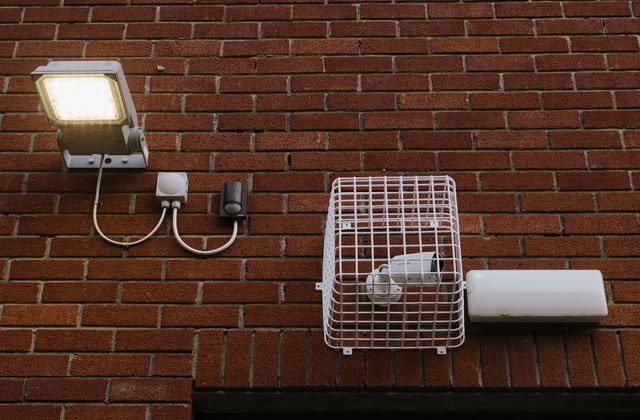
Where the sensor goes matters most
Motion sensors react to moving warmth, so they pick people up most reliably when someone crosses their view rather than walking straight at them. Mounted too high, they miss people. Aimed at the street, a shrub or next door's yard, they fire all night for cars, branches and cats.
The light and the sensor don't have to face the same way. A floodlight can light the door or driveway while the sensor is angled to catch the path people actually use. Think about glare as well: a bright floodlight shining into a neighbour's bedroom is a quick way to fall out with them.
Why sensor lights misbehave
- Comes on for no reason: the sensor can see moving branches, traffic, or warm air from an air conditioner or heat pump unit.
- Stays on all the time: it's in manual override, the time setting is turned right up, or the sensor has failed.
- Won't come on at night: the darkness setting is wrong, the wall switch is off, or the lens is dirty or sun-faded.
- Flickers or buzzes: often a new LED floodlight that doesn't suit an old sensor, or a loose connection that needs an electrician.
Settings to try first
Most sensor heads have small dials for how long the light stays on, how sensitive the sensor is, and how dark it must be before it works. Where those dials sit on the outside of the unit, adjusting them is like setting a timer. You'll need a ladder and someone to hold it.
Many models also have a manual mode you set by flicking the wall switch in a pattern, so check the instructions for yours. If the dials and switch don't fix it, or anything sits behind a cover, it's a job for the electrician.
Swapping or adding a hardwired light
Replacing an old halogen floodlight with an LED sensor light is the most common version of this job, and it still needs a licensed electrician. NSW Fair Trading tells homeowners never to install, replace or move lights unless they're qualified, and changing a globe is the only upkeep it leaves to you.
Adding a light where there isn't one usually means running cable through the roof space to the eaves. In an older home, that's a good moment to ask what state the roof wiring is in. Old rubber and cloth wiring explains what an electrician might find.
An electrician who does plenty of security lighting will suggest where the sensor should go, rather than just putting the new one where the old one was.
What's yours to do
You can
- Decide where the light and sensor go, and walk the path at night to check the angle.
- Turn outside dials for time, sensitivity and darkness.
- Wipe the sensor lens and trim plants that move in its view.
- Put up battery or solar sensor lights.
Leave to a licensed electrician
- Replacing or moving a hardwired sensor light or floodlight.
- Adding a new light, switch or cable run to the eaves.
- Fixing flicker, buzzing or a light that trips the safety switch.
- Connecting lights to a smart switch or a camera system.

If it were our house
We'd walk the property after dark first and note where people actually come and go. Then we'd have fewer, well-aimed sensor lights covering those paths, set to stay on just long enough to get a key in the door, rather than floodlighting the whole yard. If an old halogen floodlight is still hanging on, we'd get it changed to an LED sensor model in the same visit as any other outdoor work.
Want a specialist to sort it?
Tell us the job and your postcode. We match the licence-checked local electrician who does this kind of work, and they call you. No ring-around, and your number goes to them alone.