
Set it up yourself, or book an electrician?
| You can set it up | A licensed electrician fits it | |
|---|---|---|
| Lights | Smart globes in your existing fittings | Smart switches and dimmers, and modules hidden behind a switch or near the light |
| Power | Smart plugs that go into a power point | Smart power points that replace the old ones |
| Fans | A plug-in fan on a smart plug | A smart controller for a ceiling fan |
| Front door | Battery or plug-in video doorbells | Wired intercoms and door stations run from mains power |
Why plugging something in isn't electrical work
The line in the law sits at the power point. Queensland and Northern Territory law both say plugging an appliance into a power point isn't electrical work, the ACT says the same of plugging in and unplugging, and New South Wales doesn't count plug-in items as part of your electrical installation.
Globes are the other exception. Ausgrid and NSW Fair Trading both carve out changing a light globe, so a smart globe going into a fitting you already have is yours to do.
Whatever you plug in, look for the Regulatory Compliance Mark (RCM). In-scope electrical equipment can't legally be sold in Australia without it, so a smart plug bought online that doesn't carry it is one to leave in the box.
The smart switch ranges an electrician is likely to suggest
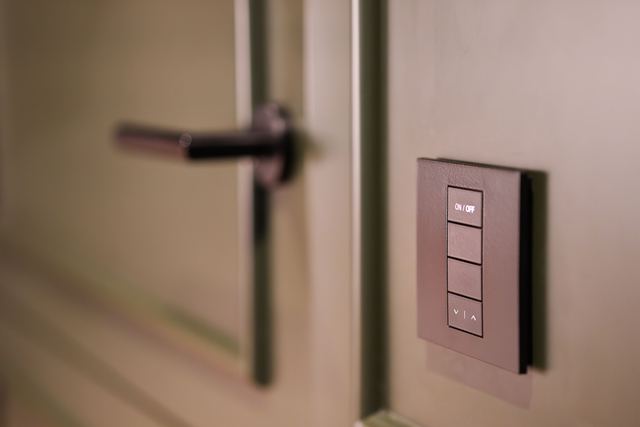
Clipsal's Iconic range comes with Bluetooth and Zigbee smart options. Its Wiser Connected Smart Dimmer is rated 300 W at 240 V and works at the wall or remotely through the Wiser system.
To keep the switches you have, Clipsal's Wiser micro module dimmer sits in the wall box or an installation box near the light and turns a traditional switch into a connected dimmer. It handles LED, halogen, fluorescent or incandescent lights up to 200 W.
Legrand's Excel Life Smart range includes smart switches, smart dimmers, wireless scene switches, smart power points and a smart fan controller, plus a gateway module that also works with Arteor with Netatmo. Legrand says each device can be run by touch, voice or a smart device. Clipsal Iconic and HPM Excel go into each range in more detail.
Hubs, apps and voice control
Clipsal says Wiser works with most of its existing wiring devices, Iconic included, and can be voice controlled with Google Home or Amazon Echo.
You don't always need a hub to start. Clipsal's Iconic Outdoor catalogue says connected devices that start in Bluetooth mode run from the Wiser by SE app with no hub, and can be switched to Zigbee later to join a Wiser Hub for remote access, scenes and voice control.
Check that what you're quoted is current. Schneider Electric's pages show the Bluetooth versions of the Iconic Wiser smart switch and push button smart dimmer were discontinued on 31 August 2026, while the Zigbee dimmer is still listed. Its older Wiser Room app is being discontinued too, and won't get further updates.
What we couldn't confirm
A common question is whether a smart switch or dimmer needs a neutral wire at the switch. Neither Clipsal nor Legrand says on the pages we could read, so we won't guess. Have the electrician check your switch boxes against the exact model before you buy.
Warranty lengths for these ranges weren't on the makers' pages we could read either, so ask the electrician or the supplier.
The certificate, and a Northern Territory rule to know
Smart switches and power points are electrical installation work, so you get a compliance certificate once they're in. In Victoria that's a COES, and lights and power points count as non-prescribed (minor) work. South Australia's eCoC has to reach you within 30 days. In Tasmania the electrician records the work in an approved form and gives you a copy once it's energised.
In the Northern Territory, from 1 December 2028 a person can't do electrical work on a home's installation unless an approved safety switch is fitted, apart from connecting the home and urgent or emergency work. If your NT board has none, plan for one alongside the smart switches.
Yours to set up, or licensed work
You can
- Plug in smart plugs, speakers, hubs and Wi-Fi units.
- Screw smart globes into existing light fittings, with the light switched off.
- Set up the apps, scenes, timers and voice control.
- Stick up battery sensors and doorbells that don't connect to your wiring.
Leave to a licensed electrician
- Smart switches, dimmers and fan controllers in the wall.
- Micro modules behind a switch or near a light.
- Smart power points, indoors or outdoors.
- Wired intercoms, door stations and anything that needs mains power run to it.
What to ask the electrician
- Which models will work with the wiring in my switch boxes?
- Will these dimmers suit my lights, and are my globes dimmable?
- Do I need a hub now, or can I start with Bluetooth and add one later?
- Are the models you're quoting current, or on their way out?
- Which certificate will I get, and what's your licence number?
Who to match with
An electrician who fits smart switches every week knows which models suit which wiring, and which apps are on their way out. Tell us the rooms and the range you're leaning towards, and we'll match you with one near you.

Where we'd begin
We'd pick one system before buying a single device, have an electrician who fits smart switches regularly check the switch boxes, and start with the lights you use every day. The plug-in gear can follow whenever you like, because that part's yours to set up.
Want a specialist to sort it?
Tell us the job and your postcode. We match the licence-checked local electrician who does this kind of work, and they call you. No ring-around, and your number goes to them alone.