
Brisbane things that change a fan job
Humid, not just hot
Afternoon humidity in the city averages 52%, and summer dew points sit around 20°C. A fan moves air across your skin, which is what helps on a muggy night when the thermometer alone doesn't look too bad.
High ceilings in timber homes
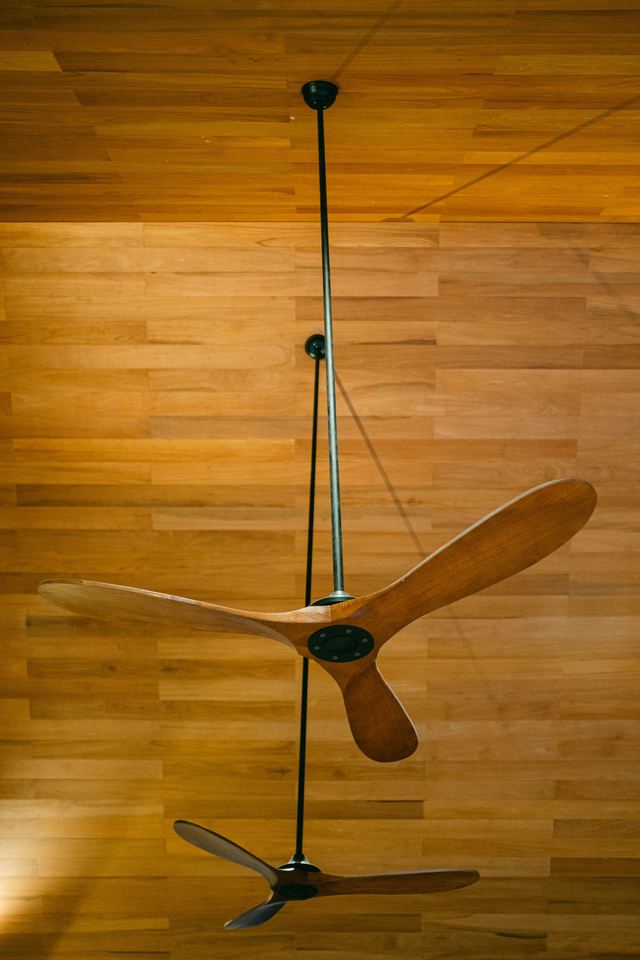
Queenslanders were built with high ceilings. A fan mounted close to a tall ceiling can sit too far above you to do much, so ask about a longer drop rod and check the maker's guide for the heights it suits.
Verandas, open and closed in
An open veranda needs a fan its maker rates for outdoor or damp locations. A veranda that's been closed in as a bedroom is an indoor room again, and it'll need a smoke alarm as well as a fan.
Under a corrugated iron roof
Most Queenslanders have corrugated iron over the ceiling, and the electrician works up there. Queensland expects the power to be off, where reasonably practicable, before a worker goes into the roof space, so plan for some time without it.
Old boards and the safety switch rule
In a home where no approved safety switch protects the power points, a Queensland electrician generally can't do installation work, a fan included, unless the job adds one. That's where older Brisbane houses can surprise people.
What the job involves in an older house
Swapping a light for a fan usually reuses the existing cable, with a fan controller added to the wall plate. In a timber house with a roomy roof space, a new point where there's never been a light is usually straightforward. Rooms built in under the house take more planning, because their ceiling has a floor above it.
The fixing matters more than the fan. A fan pulls and shakes as it runs, so it's fixed to a joist or a bracket made for the job, and an old ceiling can need a piece of timber added first.
Once it's done and tested, you get a certificate of testing and compliance with the contractor's licence number and the test date on it.
Which fan where, in a Brisbane house
| Bedroom or living room | Open veranda or patio | |
|---|---|---|
| Fan type | An indoor fan that suits the ceiling height | One its maker rates for outdoor or damp locations |
| Control | Wall control or remote, with the light on its own switch | A wall control by the door, so it's easy to turn off |
| Worth checking | Blade clearance, and a drop rod for a high ceiling | That the area is covered, and the wiring suits the weather |
Your part, and the electrician's
You can
- Measure the floor-to-ceiling height in each room before choosing a fan.
- Clear the way to the manhole so the electrician can get into the roof.
- Send the fan's model number and a photo of the ceiling with your request.
- Use the fan's reverse setting in winter, if it has one.
Leave to a licensed electrician
- Fixing the bracket and fan to the ceiling, and all the wiring.
- Adding an approved safety switch if the board needs one first.
- Wiring an outdoor fan on a veranda or patio.
- Putting a fan where there's no light point now.

What we'd ask for
We'd do the bedrooms first, each fan on its own wall control with the light switched separately, and an outdoor-rated fan on any open veranda. In an older Queenslander we'd ask the electrician to look at the switchboard when they quote, so a missing safety switch shows up on paper and not on the day.
Want a specialist to sort it?
Tell us the job and your postcode. We match the licence-checked local electrician who does this kind of work, and they call you. No ring-around, and your number goes to them alone.