
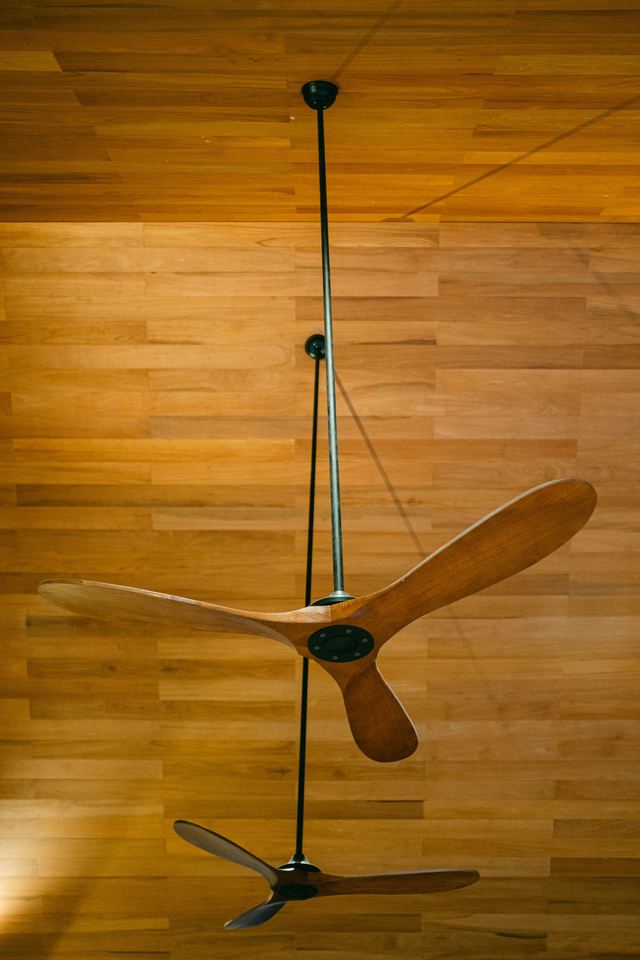
Why fans earn their place in Adelaide
Heat comes in long runs
Adelaide's record is 46.6 °C, set on 24 January 2019. In the heatwave that began on 26 January 2009 the city stayed above 40 °C for six days in a row, and in March 2008 it had 15 consecutive days at or above 35 °C. The heat arrives on hot northerly winds from central Australia.
Then a cool change
A south-westerly off the Southern Ocean can drop the temperature fast. Those are the evenings a fan does the job on its own, without the air con running all night.
Single-storey homes, reachable ceilings
Adelaide's suburbs are mostly single-storey detached houses, so there's usually a roof space right above the room. That's where the electrician works from to fix the bracket and run cable to a new fan position.
Stone and Trust-era ceilings
In bluestone cottages and older Housing Trust homes, the ceiling and the lighting circuit are as old as the house. The electrician checks what's above the plaster, and whether a safety switch protects that circuit, before adding a fan to it.
The Hills run cooler
The Adelaide Hills are generally a few degrees cooler than the plains, and frosts are common in the valleys. A fan with a reverse setting that pushes warm air back down from the ceiling gets some use there in winter as well.
Fans and air con in an Adelaide house
Air conditioning cools the room. A fan cools the people in it by moving air across their skin. On a 40-degree day you'll want both, and the fan lets you set the air con a few degrees warmer and still sleep.
Bedrooms come first for most families, then the living area. A covered alfresco is worth a fan too, as long as it's one its maker rates for outdoor or damp use.
If the air con already trips the power on hot afternoons, tell the electrician. A fan adds very little load, but a board that's struggling in January needs looking at regardless. Switchboard upgrades in Adelaide explains what's usually involved.
What the job involves in South Australia
In SA, the work has to be done by a registered electrical worker for a business holding a CBS contractor's licence, even when you're swapping an old fan for a new one. They fix the fan to a joist or a purpose-made bracket, wire it to the control you've chosen, and balance the blades.
When it's finished you should get an electronic certificate of compliance (eCoC) within 30 days. It confirms the work was tested and meets the Australian Standards.
Worth asking before the fan goes up
- Can the existing light point and switch be reused, or does it need new cable from the roof space?
- Does a safety switch protect the lighting circuit you're adding to?
- Can the fan and its light be switched separately?
- Is this fan rated for the alfresco, or only indoors?
- Can you do every bedroom in one visit?
- What's your CBS licence number, and when will the eCoC arrive?
What's yours to do, and what's licensed
You can
- Pick the fan, the size and the control.
- Measure each room and the ceiling height.
- Clear the path to the manhole so the electrician can get into the roof space.
- Flick the reverse switch, if the fan has one, when the weather turns.
Leave to a licensed electrician
- Taking down a light and fitting a fan in its place.
- Fixing the bracket and running any new cable.
- Fitting the wall control or remote receiver.
- Any fan on an outdoor area.

If we were cooling an Adelaide house
We'd put a fan in every bedroom before adding another split system, and get them all fitted in one visit in spring, before the first heatwave rather than during it. We'd send the electrician the fan models and a photo of each ceiling first, and ask for each fan and its light on separate switching.
Want a specialist to sort it?
Tell us the job and your postcode. We match the licence-checked local electrician who does this kind of work, and they call you. No ring-around, and your number goes to them alone.